
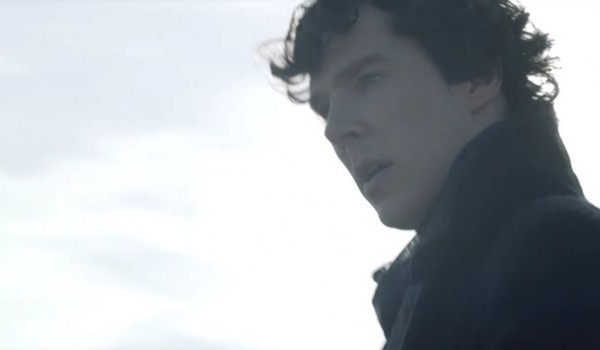
Ever since the Sherlock series 2 finale fans have been speculating how the master detective pulled off one of his most impressive feats yet. We think we’ve got the answer.
Spoilers if you’re yet to see the Sherlock Series 2 finale!
–
–
–
–
–
–
–
HOW DID SHERLOCK ESCAPE DEATH?
We all saw him jump, but there’s little doubt that he’s alive by the end of the episode, watching Watson mourn his passing at his own funeral. So how did he Sherlock survive the Reichenbach Fall?
Before we look at the possible explanation, let’s quickly go over some less likely alternatives:
1. Watson thought he saw Sherlock fall to his death because the clever detective administered him with the fear toxin from the secret research base in “The Hounds Of Baskervilles.”
2. Watson didn’t jump at all and instead threw Moriarty’s ‘dead’ body from the roof, where it was switched with a Sherlock lookalike after hitting the ground. This would involve the help of Molly, Mycroft or the Homeless Network.

Now here’s what we think happened:
- Before meeting Moriarty on the roof, we see Sherlock ask Molly for her help.
- Being a medical professional, she would be able to help falsify his death, especially if Mycroft is also in on the ruse.

Sherlock, who seems genuinely shocked by Moriarty’s ‘suicude’, puts his plan into action. We believe it could well consist of the following steps:
- He gives an emotional goodbye to Watson so that the good doctor believes Sherlock is going to jump to his death — essentially planting an unkillable idea in his mind (a concept foreshadowed earlier in the episode).
- He ensures that Watson stands a certain distance away from thee building, so that he doesn’t make it to the landing spot in time to see everything.
- Sherlock jumps from the building onto a pre-arranged truck (above) filled with ‘rubbish bags’ (presumably containing something to break his fall).
- Molly/Mycroft then apply blood to his face before he lies down on the ground, the truck still obscuring the full extent of the ruse.
- While this is happening (remember, we’re dealing with seconds here), a biker hired by Sherlock intentionally bumps into Watson, knocking him to the ground where he hits his head and becomes disorientated — his narrative is now unreliable, as he’s missed at least a 5-10 seconds. That’s all Sherlock needs.

- The truck conveniently drives away with Molly/Mycroft having performed their part of the ruse.
- Disorientated, Watson makes his way over to Sherlock’s ‘dead body’, where a crowd of Sherlock-arranged passers by (The Homeless Network) have already gathered.
- The combination of the crowd’s reaction and Watson’s disorientation means he doesn’t perform a proper check for Sherlock’s pulse and succumbs to the unkillable idea that Sherlock is dead.
- Sherlock is carted away extremely quickly by ‘paramedics’ hired by Sherlock (Molly/Mycroft would be able to falsify his death report).
- Watson, and crucially, the assassins, believe that Sherlock is dead.

But of course, he isn’t dead — just his legend (for now)..
There’s some wiggle-room in there for Sherlock to have been carried away in the truck after making the jump, with Molly/Mycroft rolling a dead corpse onto the ground where he would have landed. This corpse would presumably be the Sherlock lookalike that Moriarty hired to kidnap the kids, or someone altered to look like Sherlock, of which there’s already a precedent when Irene Adler faked her death by using a body double, so it’s not impossible that Sherlock could have done something similar, with the aid of Molly/Mycroft.
Whether there was any of that fear toxin used within this ruse is up for debate. I’m not sure it’s necessary, but it could have been used on Watson and/or the assassins to further fool/distract them.
I also think it’s important to note that even at the funeral, Watson has a nagging belief (hope) that Sherlock isn’t dead. Perhaps in the subconscious recesses of his mind the actual narrative of events is trying to break through?
Now, all of that could be way off the mark, and we accept that one or two aspects of the explanation might be a bit of a reach. We also recognize that there are one or two other curious moments that might come into play (Sherlock throwing his phone on the roof before jumping, Moriarty’s supposed suicide, etc), so there’s plenty of room for anyone to refute or build on this possible explanation. In the meantime, what a cracking finale it was, eh?




PERSON OF INTEREST Renewed For Season 2
TERRA NOVA: Season 2 Decision Delayed Until 2012
ONCE UPON A TIME: The Comprehensive Character Guide
FRINGE OBSERVATIONS: 4.22 Brave New World: Part 2
ONCE UPON A TIME OBSERVATIONS: 1.22 A Land Without Magic
ONCE UPON A TIME OBSERVATIONS: 1.21 An Apple Red As Blood
FRINGE OBSERVATIONS: 4.21 Brave New World: Part 1
ONCE UPON A TIME OBSERVATIONS: 1.20 The Stranger


{ 25 comments… read them below or add one }
A great finale. There’s something wrong with a season finale that airs 2 weeks after the season debut, but that’s another matter.
I love Watson’s skepticism about “The Fall”. I would have to do a rewatch to get this clear in my head, but how would Sherlock know that he would have to have a pre-arranged swan dive in place? Is this why he set up a meet with Moriarty on the roof in the first place, because he and Moriarty are “the same” and this is how Sherlock would have played it if roles were reversed? Did he play Moriarty like a Stradivarius?
What to make of those tears flowing like wine down Sherlock’s face just before the jump. Were those for the pain he was about to inflict on Watson and/or his landlady? Was he mourning the loss of his (almost) intellectual equal, and the matching of the wits with Moriarty that Sherlock no doubt thoroughly enjoyed?
A tip of the Sherlock Holmes hat to the Beeb for bringing us good stuff to watch.
Like:
1
“I love Watson’s skepticism about “The Fall”. I would have to do a rewatch to get this clear in my head, but how would Sherlock know that he would have to have a pre-arranged swan dive in place? Is this why he set up a meet with Moriarty on the roof in the first place, because he and Moriarty are “the same” and this is how Sherlock would have played it if roles were reversed? Did he play Moriarty like a Stradivarius?”
Good point, Page. I’d go along with your answer. I think Sherlock had to think like Moriarty in order to ‘defeat’ him. I saw the fall as his failsafe — something he pre-planned just in case he couldn’t find any other loophole in Moriarty’s bind.
“What to make of those tears flowing like wine down Sherlock’s face just before the jump. Were those for the pain he was about to inflict on Watson and/or his landlady? Was he mourning the loss of his (almost) intellectual equal, and the matching of the wits with Moriarty that Sherlock no doubt thoroughly enjoyed?”
Such an interesting moment! I think it’s a bit of both, which is to say I think Sherlock would have tried to convince Watson in this way. But, ultimately, I think the tears were geniune. I think the stakes were high at this point (he could have missed the giant “X” on the truck) and he knew that an extended separation from his pal was on the cards. Or perhaps that’s how I’d like to read it.
That said, I’m intrigued by the possibility that a part of him was also mourning Moriarty.
“A tip of the Sherlock Holmes hat to the Beeb for bringing us good stuff to watch.”
Indeed! I thought 2.01 and 2.03, in particular, were exceptional. Fingers crossed for more seriability in S3, perhaps?
Like:
1
I don’t know if anyone else heard it, but as Sherlock asks JM to give him a few moments on the roof top, we hear a very quiet (almost inaudiable) beep and then a female voice (presumably Molly) saying “Hello?!”. It’s as if Sherlock reached into his pocket and called someone as a signal of some sort.
How this fits in I’m not sure… but it happens before JM’s death so doesn’t quite fit with your version outlined above…
Like:
4
…maybe I just made that up… but there’s definitely some sort of sound…
Like:
1
I’ll have to check on that — thanks for the tip, Heg.
Like:
0
HOW did it work then?
Planning must have started quite early on before the release of Moriarty during “Hound” and also before “Scandal”. Mycroft had a deal with Sherlock that they could catch Moriarty by exposing Sherlock (who annoys Mycroft by literally exposing himself in “Scandal,” wearing only a sheet/shroud which he then leaves with his brother, note that Gandhi, Jesus, Caesar were all wearers of sheets and that in Freud, nudity symbolizes vulnerability and innocence as much as the will to be seen for what one truly is). In return to this favor, Mycroft has to help Sherlock get into Baskerville. The plan revolves around Sherlock’s death. Mycroft is sorry because he knows how hard this vanishing act is for the younger brother, but still order has to be restored (as Sherlock says). So the plan goes: Moriarty, in a mad frenzy, challenges Sherlock, all parties involved seemingly on Moriarty’s side. He is even found not guilty by the frightened jury in “The Fall”. His next step is to go and see Sherlock, who, regardless of John’s advice, has made himself an enemy among the press, one he knows to be thirsting for a career. He would not be so stupid to risk his reputation unless he actually wanted it destroyed. Mycroft must protect Sherlock and has installed several snipers to watch his brother. Some are killed though. Mycroft also asks John to keep an eye on Sherlock. Stupidly, Sally wants Sherlock arrested because the little girl screamed when she saw Sherlock. This might mean that she saw a man in a Sherlock hat (as John has re-named the deerstalker; the relevance of hats is stresses on Connie Prince’s website) and made a connection between the man and a story Moriarty told her. Lestrade who is in on the plan tries to avoid the arrest (he looks sad when Sherlock focuses the little camera on him, possibly Mycroft’s surveillance), but eventually has to go by the book and arrests Sherlock who then runs for it. The police, mind you, don’t follow. At Kitty’s, Sherlock and John meet Moriarty who tells them another fairytale, but Sherlock does not argue. He does not utter a single word in his defense. Moriarty escapes, but Sherlock knows that Moriarty used Kitty (and her deerstalker hat) to scare the children, because he knew her hunger for revenge. She hated Sherlock who would not give her an interview. Moriarty gave her the perfect story, so why not be economical with the truth and construct the abduction to make Sherlock dance? Knowing this, Sherlock decides to outwit Moriarty. He and John go to the lab where Molly notices how sad Sherlock looks. He knows she’s right and is shocked by how observant she can be. So he sends her away to 1) protect her, but also to 2) get her out of his way. He tells her that he is a fake and asks her to tell Kitty which Molly does (we do have immediate press reactions on John’s blog). His reputation irreversibly destroyed, Sherlock gets in touch with Mycroft and mad Jacob to organize his fall. For this, he has all night. In the morning, he only needs to send John away under the pretext of Mrs. Hudson having been shot, before he asks Moriarty round. Sherlock names the place. John, of course, finds no injured old lady, and heads back. He knows Sherlock is on one of his kamikaze missions again and might need his help. While Sherlock talks to Moriarty and lets him know they’re equals (and Moriarty tells him that he has snipers watching Sherlock’s friends), Mycroft’s people prepare the pavement for Sherlock’s fall. There is a sheet on the bus, there are paramedics and there is the rubbish van with some equipment. Sherlock pretends to be less clever than he is, so Moriarty can feel very sure of himself. Moriarty then fakes his own death by shooting himself. Sherlock does not need to verify. He knows the bullet would have caused more damage. He also knows that the little surveillance camera he has brought onto the roof, has recorded the confrontation. Sherlock, afraid for his friends and what the snipers will do to them, panics, but goes back to calm when John’s taxi arrives. He stands on the roof facing the inner court (St Paul’s and St Michael’s would be in that direction) while wigged Jacob Sowersby, a mad fanatic who has posted a video on John’s blog and who has the same clothes as Sherlock stands at the front holding a phone. The real Sherlock talks to John giving instructions as to where his friend shall stay and keep his eyes fixed on him. He surely sees John’s reactions on some sort of monitor. There is nobody in the street at this point, but there are the vehicles. John listens to Sherlock’s long confession (about being a fake) but does not believe him. Sherlock cries at such loyalty. Maybe he’s scared of being alone. Maybe he’s desperate because John has again failed to look or rather hear the obvious (“it’s a trick, a magic trick,” as indeed it is: You tell a person to focus on a coin in the middle of a table. You cover the coin with a glass and the glass with a napkin. You then pull the wrapped up glass over the corner of the table and let the glass fall into your lap. The napkin will keep the shape of the object even after it’s gone, so you keep repeating the to and fro a little to make it more interesting before you reveal that the glass is gone!). So Sherlock holds out his arm to signal the cyclist to go for it before Jacob gives himself up (dropping the phone so that it won’t be found on the body as there had been no outgoing call. At the same time the phone call was for Moriarty to listen in on) and takes the fall. The cyclist runs John over while Jacob falls onto the sheet (the special sheet Sherlock delivered to Buckingham Palace). His face is bloodied, his pulse lowered/stopped by some drug, possibly liquid E or Ketamin AKA Kitty or H.O.U.N.D.. The traumatized John is dazed (and he always jumps to conclusions based on incomplete data) and people try to push him away, but he manages to take Jacob’s non-existent pulse and collapses before the body is rushed off into the hospital. Sherlock hopes for John to look and see that there is no phone on him because that’s what’s impossible: no phone on the body. John will doubt Sherlock is dead and will not lose hope.
The last scene shows that John has not looked but believes in Sherlock’s death.
Like:
0
FINALLY ! You are the only other person on the net that agrees with me on one simple premise. That – although it was SH talking to JW on the phone, it was not SH standing on the ledge. At no time during the final phone call do you see SH standing on the ledge. You get only 2 camera angles. The closeup of SH talking and the long shot from JW perspective showing somone standing on the ledge. I don’t know precisly who jumped – but I do know that it was NOT Sherlock Holmes.
Like:
0
Actually, since Moriarty killed himself by shooting a gun in his mouth with the gunpoint directed at his brain, there would be very little blood. This murder method was used in Agatha Christie’s The Tragedy at Marsdon Manor. The bullet would lodge in the brain, creating internal hemorraghing, some bleeding from the mouth, and an appearance of seemingly natural death. Obviously, Moriarty wasn’t deliberately going for this effect so there may have been more injury to his head, but it is highly possible that Moriarty did kill himself and that there was as little blood as was seen.
Like:
0
I was thrilled with the ending, I was waiting for Sherlock to appear, I only thought it would happen on the reflective image of the gravestone after John walked away, showing Sherlock appearing in the reflection and looking after John. I think the way it was done didn’t have as much…’affect’ as it could have, but I loved it none the less.
So we know Sherlock isn’t dead, and the shock at Moriarty’s suicide did indeed look genuine, but I think the whole situation begs the question, “Is the devious genius Moriarty really dead?”
If Sherlock was able to plan such an elaborate fake suicide on himself, it leaves us open to believe Moriarty may very well have faked his own death, [and I must point out, his head wouldn't quite look like that after blowing a bullet through his brain]
But all in all; it posed the proper question, left us at the edge of our respective seats, gave us a side of Sherlock we loved to see [fake it may have been] and it left us itching for more, so I believe the Sherlock series 2 writers accomplished what they set out to do, they wrote an amazing, elaborate story that has me waiting on the edge of my seat for the next season.
Like:
0
I always wish to comment on another aspect of the episode.
I loved how they wrote in Moriarty’s ‘suicide’, he finally got what he wanted.
He always said, ‘We’re the same, you and I’
And to finally hear Sherlock admit [and we know he meant it in a way] that they were indeed the same, was almost like…..the ending to his game. Like everything he set out to do was to make Sherlock realize they were the same.
And I like that idea, Sherlock is a genius, but he is detached, self-absorbed, arrogant, lonely and believes no one can better him.
Sherlock may not be a ‘criminal-for-hire’, or kill people, but in the end, Moriarty and Sherlock are indeed ‘the same’.
Like:
0
Moffat and Gatiss have cerebellums like spiral staircases.
Like:
2
On the roof, Sherlock does not enquire of John as to Mrs Hudson’s state of health after John’s dash to her side across half of London. Odd, when he was happy to chuck a thug out of a window for frightening her and roughing her up. In the original story, Holmes says in his note that he suspected the message to Dr Watson about a sick woman at the hotel to be a ruse. Sherlock says;…”I want you to tell Mrs Hudson,”…etc., (that he is a fake). Sherlock must know that she is alive when he says this.
Also, the fall wasn’t a ‘whee-splat’ type suicide, it was measured and controlled to some extent. That coat of his is nicely voluminous too. Of course it could have been the only way the BBC stuntman could fall in order not to break his neck. Fine work on his part whatever the reason. Worthy of Alf Joint and Marc Boyle.
Kudos too, to whoever painted the Reichenbach Falls, Turner-style.
A final couple of points, all this cobblers about throwing dead bodies off the roof etc., Dead bodies are notoriously floppy, heavy and as unco-operative as a sack of spuds. Plus the paramedics whisked the ‘body’ away damn fast. Maybe this is standard practice with a corpse, but it was very quick.
Well, that’s thrown my two pennyworth into the melange anyway.
Like:
1
He does not need Molly or Mycroft to provide any blood. He a) has lots of blood on the roof provided by Moriarty – or, even more probable b) he brought a couple of bags of blood with him.
So he does a stunt dive onto the blue and red airbags on the truck, rolls over onto the sidewalk smearing blood all over himself. Uses little blue rubber ball to stop his pulse.
For those of us not familiar with the topology (and the short brick building is conveniently not shown in the episode) Dr. Watson starts out here
http://g.co/maps/pfy2n
and runs / gets run over by bicycle here:
http://g.co/maps/cpmvx
http://g.co/maps/r2rsv
http://g.co/maps/tchrf
http://g.co/maps/xq3xt
http://g.co/maps/5vhbn
M C Ertem
Like:
1
Some really good ideas here guys!
Like:
0
I think we have a real long con going on here, starting, at the latest, with Mycroft feeding hatred and Sherlock’s life story to a detained, demented Moriarty. All the publicity that Sherlock takes part in at the beginning of the episode is designed to taunt and aggravate the Spider. Moriarty rises to the bait, and Sherlock deliberately bates the journo in the Men’s, and then feeds her name to Moriarty when they are in the court jail together. This ensures that a truly damning story – the big lie sold by the lots of little truths – will emerge when Moriarty goes to the journo.
Moving on, Sherlock now knows that the sword is going to fall soon – and Moriarty will try to ‘burn’ him – but he doesn’t really know the when or precisely how. He does what he can to swing the balance his way: he is the one who makes the rendezvous for the roof, after all, which means he has the opportunity to set things up earlier. He only starts the ball rolling when he realises how Mycroft fed him the false key code information – he needs that information to draw Moriarty out. The squash ball proves that Sherlock is the jumper (it means that Watson won’t be able to find the pulse in the ‘dead’ Sherlock’s obligingly held-out arm).
Now, since Moriarty is a spider at the middle of an enormous web etc., it is important to have a means of discrediting him with the rogue governments. I have a feeling that the bug Sherlock found in his flat is somewhere on the roof, recording Moriarty’s boasting about the fake key code (which Sherlock could only have found out about from Mycroft, who ‘found it out’ from Mycroft) and the snipers intending to kill Watson, Lestrade and Mrs Hudson. He also leaves his phone on the roof when he jumped, which means that there is possibly more damning evidence on THAT which he needs to protect from the fall. Much of his fear is genuine – the stunt fall could go wrong, which would have enormous repercussions.
Anyway, back a bit. Sherlock is very inconsistent – deliberately so – in this episode (I’ve already talked about the Private Detective becoming a provocative media whore), but he also tells Lestrade that he has no intention of letting himself be arrested on suspicion of the kidnap as a photo op., and then deliberately GETS himself arrested in a photo op. Ergo the escape was planned, as was his calling on the journo, for gathering more puzzle pieces. She gave him her card, remember, and Moriarty HAS to believe that Sherlock is making terrible mistakes, so that he will be overconfident. It’s the sugar in the icing that John witnesses this.
This means that a lot of Sherlock’s posturing on the roof is acting for a criminal network/rogue government audience, though I do think that he is figuring the angles to get Moriarty to kill himself. Of course Moriarty’s dead: Sherlock is planning his own fake death, knows about the two fake deaths of Irene Adler, so is hardly going NOT to check whether the brain matter and blood coming from Moriarty is fake or coming from a bloody great hole in Moriarty’s head.
The Spider’s criminal network needs bringing down, so Mycroft will be able to use the recorded information to work on that. Sherlock needs to stay dead until all the loose ends are cleared up, or Mrs Hudson, John and Greg will die.
Not sure exactly what Molly’s role in all this is, but she was possibly behind the quick arrival of the medics, may have provided the cackle-bladder blood and/or may fake the autopsy – with Moriarty’s body standing in for Sherlock’s. However, keeping the secret of what really happened is paramount, so the less that fewer people know(does that make sense?), the better.
So, when John arrives back at Bart’s – having been sent to see a decoy dying Mrs Hudson by Sherlock (maybe that’s what Molly did?), who needs to keep him at arm’s length – his positioning is crucial. A low building blocks his view of the pavement and ensures that any snipers also don’t see the fakery. I don’t know if the cyclist that knocks Sherlock over is Homeless Network or MI5/6/7, but his purpose is two-fold: to delay and to disorientate John, so that Sherlock can get out of the carefully-placed cardboard box- or whatever-filled container he had to leap into so spectacularly, and arrange himself with blood and ball in his armpit; and so that the carefully positioned (see the chalked rectangle on the pavement?) container can be driven away.
Why is Sherlock such a liar to John, telling him that he IS a fake? An act of love: I think he thinks that if he can get John doubting even a bit, then real anger might displace utter devastation. Mycroft needs to keep up his stony silence until all the loose ends are tied – but remember that in the stories he is referred to as being even cleverer than Sherlock, so I really don’t think he screwed up: I think he was an integral part of Sherlock’s planning.
In my defence, I am sick in bed, thus giving me too much time to work on this. I haven’t forgotten the hanged man, thumbs in the fridge or girl’s scream (I imagine she could be traumatised by being shown loads of pictures of scary Sherlock. I don’t think there can be a mask – too much room for error, and how could a life-mask be made of Sherlock?). Even in the best detective stories, red herrings are essential.
When the whole thing is explained in the beginning of the third series, it will probably turn out to be something to do with the hanged man, a jar of thumbs and a Sherlock mask. Such is art…
Like:
1
Interesting theory! Now that I think about it, the hanged man could be Sherlock already planning ways to commit suicide. We all know he was annoyed by the media attention (this is before he deliberately played it up – he was annoyed as early as the first episode of season 2) so a faked suicide would have the added incentive of letting him return to being a private detective.
What mystifies me is who they buried. Unless of course they used a closed casket. Otherwise, wouldn’t the body have been recognized at not being Sherlock at the funeral?
Like:
0
I personally believe that there are two Sherlocks.
One of the Sherlocks is played by Sherlock himself, whilst the other is played by Mycroft.
Mycroft decides to release Moriaty, he admits to John that he was able to open Moriaty up when he spoke to him and then allows Moriaty access to his younger brothers past. Why on earth would he do that without good reason, especially when you consider how much he cares about Sherlock? On countless occasions he asks John to act as a guardian.
It would also explain as to why Mycroft and Sherlock avoid contact in the episode, as well as the fact that you don’t see both Sherlock and Mycroft in the same room at the same time.
There is also a line when Sherlock fears John may see him as a fake, to which Watson replies something like “no, I know you’re real. Who else could fake being such an annoying idiot?”. That, to me, was a big heads up and possible suggestion that Sherlock is not who he seems to be throughout the episode. With the only ther person able to portray him in a slightly similar way being his older brother, because they’re very similar and are family.
This is why there is reference to something “out of character”, quite possibly because at the time he does it, Mycroft is portraying him. Therefore there is always likely to be an error because it’s not the real Sherlock. We know of a Sherlock mask, because we’re lead to believe that when the two children were taken, because the girl recognises him when he enters the room. Possible hint?
This also explains the death sequence, in that either the real Sherlock is on the roof with Moriaty and then jumping to his death, or it’s Mycroft. Then, the opposite Sherlock is the one who plays dead.
There are many references in the episode that hint at this possible theory.
But, in Sherlocks time of need, for his brother not to be aiding him is unlikely.
Like:
0
Anyone catch the shoe references?
Like:
0
Just a few thoughts of my own, especially as the producers of BBC’s Sherlock say that there is a clue people have missed….
It could be that Sherlock faked his death by a clever landing as others on the forum have suggested, but also made sure no pulse would be found by John by using some pollen from the Rhododendron Ponticum flowers that we know he may have had access to earlier in the episode (why else would they have picked that species).
This idea has been used before (see the case of lord Blackwood’s faked death in Ritchie’s 2009 Sherlock Holmes) – and when we see Sherlock on the rooftop pressing his sleeve to his face, one cannot help but wonder if he is inhaling the pollen which is where the toxins are concentrated anyway.
If I remember well, right after that we notice his breathing start to change, first slowing then becoming erratic later.
In that case, he had likely planned to take the jump all along, and manipulated Moriarity to commit suicide so that the nutjob would not be a threat to society any longer or Sherlock’s friends, and then just as in the “Final Problem”, the only thing left to do would be to convince Watson of his death – which would in turn convince the rest of the world.
I’m sure that the biker was staged as a method of delaying John (probably to give the poison time to act) and that Molly’s help would be enlisted to safely revive Sherlock and cover up his survival.
Finally, I think that Sherlock’s obvious pain and fear at the end was very real, both because of the fact he knew his next actions would cause his friends great grief, but also because – especially if he had taken a poison beforehand- he would have been disoriented and weak enough to make the likelihood of him actually surviving the dive very very slim.
Like:
1
he doesn’t perform a proper check for Sherlock’s pulse >>> sherlock may have been helped by molly for that point, to my mind
Like:
0
I feel like too many people misuse the ‘dummy’ or ‘mask’ theory to explain the fall; the explanation of how this is implausible (due to it being an inelegant answer) is much more simple than this–and more importantly, it re-iterates a much more common theme that Moriarty states: “you always want everything to be sooo clever”.
A dummy/lookalike/mask wasn’t used for the children. Moriarty WAS ‘the Reader’ as he told the reporter and John & Sherlock. The children’s story reader, he really did do this…and with all the Hansel and Gretel talk, I think it is most elegant for Moriarty to have made out Sherlock to be the villain in this (and maybe other) childrens’ stories, which explains their fear, despite never having seen him in real life. This explanation both doesn’t rely on speculation and unlikelihood of that sort of reaction at seeing him–and also shows us the arrogance of Moriarty; he did, in fact, lead a second life for the purposes of a grander scheme–and our skepticism led us to dismiss this point countless times in theories.
Given this, I follow that the government (who funded the hallucinogen) also had been employing this PREVIOUSLY to The Hounds and it is how Irene Adler faked her death. Sherlock, believing that Irene Adler would be found dead calls Mycroft. Mycroft and Molly, using Sherlock’s suspicion–gas the mortuary–and let Sherlock convince himself she’s dead, which I predict is exactly what the biker did to John to let him be convinced of that dreadful thought (though, admittedly it doesn’t explain why he couldn’t have gassed the whole panicky crew nearby…or maybe just needed to buy time for it to kick in). This is how Sherlock is surely able to be proclaimed dead, since we can reasonably assume John would see his friend’s body a SECOND time, to declare his true death–and as a doctor, legitimize it.
Given that we can dismiss body doubles (since a body double for the fall doesn’t reuse plot elements now), I actually predict he does jump. My theory gets shaky here, as I also predict that he does hit the ground. I don’t believe he lands on the bus, and I base that on his trajectory from the sidewalk camera angle…it seems apparent his direction is simply DOWN, not down out toward the asphalt. In such a case, he survives a leg-debilitating but not life threatening injury, goes ultimately into the custody of his confederates (Molly and Mycroft), is declared dead, saves his friends, and is seen later-sitting-viewing John at his gravesite.
Like:
0
I also think Sherlock actually jumped – but my theory was that he grabbed (or was grabbed by) someone in one of the windows on what appears to be the second/third floor of the building.
(1) there were some birds which flew out of that window after the fall, indicating something had disturbed them
(2) this is closer to the actual Sir Arthur Conan Doyle series of events – although Sherlock is a modernized, retold version, the main plot twists have largely remained faithful to the original (i.e. even though the Hound of the Baskervilles was heavily retold, the fact that it was an illusion of a hound was maintained, the villain was never captured by the police, but rather was assumed to have died due to his own error)
Like:
0
Not that it’s the best evidence, but just as Sherlock is placed on the cart, the camera-angle is set from atop St.Barts (Moriarty’s point-of-view if we assume his suicide was a fake), and two pigeons take flight. Pigeons are normally very skittish creatures, and will flee if they detect the motion nearby. Given this, one would be inclined to presume that nobody can have fallen by their perch. Granted, it could be an artistic liberty with more of a symbolic value, but still it seems a mundane error to make for screenwriters this skilled.
At the same time, I agree cannot but agree with the above-mentioned theories regarding the low brick-building, the bag-filled truck and the bicyclist.
I consider it unlikely that Sherlock would allow Moriarty to escape to his life given how complex the scheme would have to be to allow Sherlock to survive. On the other hand of course, Moriartys survival could very well be integral to the calling off of the assassins. Since Sherlock could hardly be aware of what was necessary for the contracts to be called off, he might not have been willing to risk finishing Moriarty off. Given that he is a lunatic it is of course also possible that Moriarty did in fact commit suicide. At the very least if one considers the option of body-doubles, this is far more likely for Moriarty than for Sherlock.
Like:
0
I don’t know about London pigeons, but New York City pigeons are about the least skittish birds I’ve ever encountered. They usually get out of the way of cars, but they tend to be fat and lazy and will walk away from people rather than fly. You may be right about the birds in this shot, but the general statement “pigeons are normally very skittish creatures” is questionable. Also, if the pigeons were brought in for the shot, they would have trainers and be specifically non-skittish. ;D
Like:
0
I am satisfied with your explanation, but I’d just like to make an improvement. A shot of a ball at 1:06:38 (if you dont want to go back to look for it: it’s a simple, black, rubber ball held in Holmes’ hand). It is a commonly known party trick that when you place one of these rubber balls under your armpit, you can prevent your pulse being felt in that arm. (http://www.csiro.au/helix/sciencemail/activities/TrickPulse.html) It is not because Watson’s disorientation that by chance caused him to not feel Sherlock’s pulse- Sherlock would not leave things to chance like this. Instead, Sherlock made sure his pulse would not be felt by hiding the rubber ball under the armpit that would be on the side of Watson when he arrived.
Like:
1